Tuesday, July 2, 2019

wordplay - Thaw Sue's cold dog


Start with the phrase Thaw Sue's cold dog and perform the following steps in some order to find a famous question:


  • Add one letter

  • Add one letter

  • Change one letter

  • Rearrange the letters of one word

  • Rearrange the letters of one word


  • Rearrange the words

  • Remove one letter


Note: You can ignore punctuation, and add/remove punctuation as required, at any point.  Thus, Sue’s is one word.


Answer


Start with the phrase


Thaw Sue’s cold dog


and perform the following steps:


Add one letter:


Thaw Sue’s could dog


Add one letter


Thaw jSue’s could dog


Change one letter


Thaw jSue’s would dog


Rearrange the letters of one word


What jSue’s would dog


Rearrange the letters of one word


What Jesu’s would dog
Note: adding/removing punctuation is not included in the steps. → What Jesus would dog?


Rearrange the words


What would Jesus dog?


Remove one letter


What would Jesus do?


general relativity - Assumed symmetry of Christoffel Symbols


With reference to the discussion in an earlier question on the independence of metric and Christoffel symbols, it was discussed that the symmetry of the Christoffel symbols ($\Gamma_{\mu\nu}^{\alpha} = \Gamma_{\nu\mu}^{\alpha}$) is "assumed" and, therefore, there are versions of Classical GR and Quantum Gravity theories which break this assumed symmetry to derive more general results.


I have been following Schutz to study GR and how to calculate various quantities in it. In the image below I am posting (picture of) a part of p. 133 where they, seemingly, "prove" the symmetry of Christoffel symbols (instead of just assuming it).
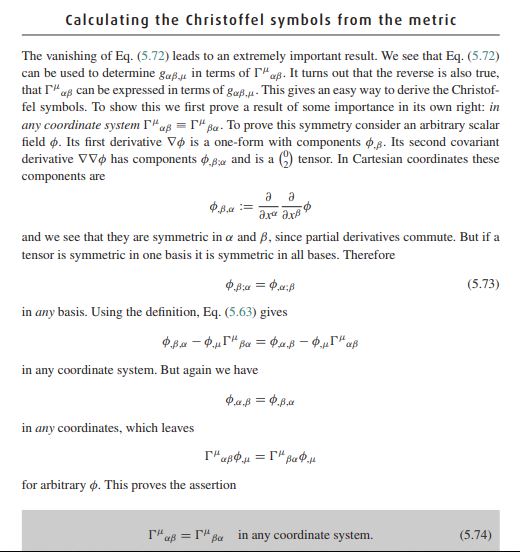

enter image description here


For reference, equation 5.72 referred to in the text is the vanishing covariant derivative of the metric tensor. And 5.63 is the covariant derivative of a second rank tensor.


I am guessing there is a subtle "point" that I am missing here because they are not "assuming" the symmetry in the book, they "proved" it.


Can anyone shed some light on how the symmetry is proved here and why not assumed?


Answer


The absence of torsion is already implicitely assumed from the start in this "proof". When Schutz says that the second covariant derivative of a scalar field in cartesian coordinates is


$$\tag{1} \phi_{,\beta;\alpha} = \frac{\partial \, }{\partial \, x^{\alpha}} \, \frac{\partial \,}{\partial \, x^{\beta}} \, \phi,$$


he's already assuming that


a) the spacetime is flat and $g_{\mu \nu} = \eta_{\mu \nu}$ (Minkowski spacetime covered with inertial cartesian coordinates),


b) the contorsion tensor is 0, and this implies that the connection is symetric.


In general, even in cartesian coordinates, the second covariant derivative of a scalar field is this :


$$\tag{2} \phi_{,\beta;\alpha} = \frac{\partial \, }{\partial \, x^{\alpha}} \, \frac{\partial \,}{\partial \, x^{\beta}} \, \phi - \Gamma_{\alpha \beta}^{\lambda} \, \frac{\partial \,}{\partial \, x^{\lambda}} \, \phi.$$


The connection (in any coordinates) can be decomposed into its Christoffel part (Levi-Civita) and a contorsion part (I'm only assuming the compatibility condition : $\nabla_{\lambda} \, g_{\mu \nu} = 0$) :


$$\tag{3} \Gamma_{\alpha \beta}^{\lambda} = \tilde{\Gamma}_{\alpha \beta}^{\lambda} + K_{\alpha \beta}^{\lambda},$$


where $\tilde{\Gamma}_{\alpha \beta}^{\lambda}$ are the Christoffel symbols. Even in cartesian coordinates, the Christoffel symbols are non-trivial functions of $x^{\mu}$ in general, except if the metric is flat (i.e. Minkowski spacetime and inertial frame). So $\tilde{\Gamma}_{\alpha \beta}^{\lambda}$ dont cancels even in cartesian coordinates! Even if $g_{\mu \nu} = \eta_{\mu \nu}$ and $\tilde{\Gamma}_{\alpha \beta}^{\lambda} = 0$, the contorsion tensor doesn't vanish and equ (1) is false.


I really don't like this "proof" from Schutz because it hides a lot of stuff and could be confusing to many students of General Relativity.


On a side comment, take note that $\tilde{\Gamma}_{\alpha \beta}^{\lambda} \ne 0$ even in Minkowski spacetime covered with cartesian coordinates! You also need to state that the cartesian coordinates are inertial to cancel the Christoffel symbols. For example, the Minkowski metric expressed in an accelerated frame (or Rindler frame) is this :


$$\tag{4} ds^2 = (1 + g \, x)^2 \, dt^2 - dx^2 - dy^2 - dz^2. $$


Even in these cartesian coordinates, we have $\tilde{\Gamma}_{\alpha \beta}^{\lambda} \ne 0$ (but the spacetime is still flat, though).


Monday, July 1, 2019

classical mechanics - The Parallelepiped on a Sloping Plane: A Reconsideration of an Old Friend


Consider the following elementary situation, which all the students of physics meet during their first-year study of classical mechanics.


A homogeneous rigid parallelepiped is at rest on a sloping plane, under the action of the weight force. Let $\alpha$ be the slope of the plane with respect to the horizontal ground.


Is there some elementary way of determining the distribution of the reaction forces acting at each point of the parallelepiped's base? Clearly, if $\alpha=0$, we expect that no friction is present and that the perpendicular reaction force is constant everywhere. But what is the answer for a general $\alpha$?


Mathematically, the problem is indeterminate, since we consider the parallelepiped a rigid body, and there are for sure infinitely many distributions (of reaction forces and internal forces) compatible with this static situation. But I think some reasonable assumption should let us find a unique solution. I am particularly interested in the distribution of the perpendicular reaction forces, that is in the pressure.


Given the symmetry of the problem, we can reduce it to a 2-dimensional one, in which the parallelepiped is replaced by a rectangle with surface density $\sigma$ which has a base along a straight line $x$ which meets the ground at an angle $\alpha$. Let $Oxy$ be a cartesian system, and let $R(\xi)=(R_{x}(\xi),R_{y}(\xi))$ be the reaction force per unit length acting on the rectangle at the point $(\xi,0)$ of its base. The issue is to determine $R(\xi)$. Note that, whatever the distribution of the friction forces $R_{x}$, the total moment of $R_{x}$ with respect to the center of mass of the rectangle is determined (its magnitude is equal to $\frac{h}{2} Mg \sin \alpha$, where $h$ is the height of the rectangle and $M$ its mass). So, the total moment of the forces $R_{y}$ with respect to the center of mass is known too: it must be opposite to that of the $R_{x}$. What assumption can we add to find the distribution of $R_{y}$?


In the special case $\alpha=0$, we can reason as follows. If you consider a vertical little strip of the rectangle, it is reasonable to assume that the neighboring parts of the rectangle exert no force on it, so that $R_{y}(\xi)=\sigma g h$ for all $\xi$ on the base. But how to reason for a general $\alpha$?


Thank you very much in advance.


PS I have never taken a course in continuum mechanics, so I apologize if my question should turn out to be trivial.


Answer


Actually, our problem is indeterminate also in the special case in which $\alpha=0$ and there is no friction, as the following reasoning shows.


Let $L$ be the length of our original rectangle $T$, and imagine to cut $T$ along the segment $S$ of extremes $(\frac{h}{2},0)$ and $(\frac{h}{2}+\epsilon,h)$ for small enough $\epsilon > 0$ so that each one of the two resulting trapezoids $T_1$ and $T_2$ is in equilibrium on the plane (with no contact forces between $T_1$ and $T_2$). This corresponds mathematically to assume that there are no internal forces in $T$ along $S$. Call $R(\xi)$ a solution of this configuration. Then $R_{y}(\xi)$ cannot be constant, since we must have \begin{equation} \int_{0}^{\frac{h}{2}} R_{y}(\xi) d \xi = g \sigma h \left( L + \frac{\epsilon}{2} \right) > \int_{\frac{h}{2}}^{h} R_{y}(\xi) d \xi = g \sigma h \left( L - \frac{\epsilon}{2} \right). \end{equation} Since this solution is as "physically reasonable" as the one found above in which $R_{y}(\xi)$ is constant, we conclude that our problem cannot be solved without information about the internal forces inside $T$.


spacetime - How to travel between two stationary worlds in the least amount of time? (time dilation)


Let's imagine there are two, isolated, stationary worlds in space (called A and B), very far apart from each other. I live on World A, and some aliens live on World B.


I want to learn about the aliens on World B by talking to them in person. My lifespan is a quadrillion years, so I'm not worried about dying while traveling to them. However, I would like to see the alien civilization as close to its infancy as possible. In other words, I would rather see alien cavemen than alien astronauts.


If I travel too slowly, I give their civilization too much time to develop into astronauts—no good.


If I travel fast enough (close to the speed of light), time passes faster for World B than for me and my spaceship, due to time dilation (correct me if I'm wrong). Thus, I'm worried that if I travel too fast, time might pass so quickly for World B that they develop into astronauts before I arrive.


Am I right to worry about this? If so, what's the optimal speed to ensure that I arrive earliest in their civilization's development? If my reasoning is wrong and traveling faster is always better, then why?


Answer


Suppose that A and B are at rest relative to each other (which you have) and in their mutual rest frame are separated by 100 light years. That means that no signal can travel from A to B (or vice-versa) in less than 100 years. Signals include optical or radio signals, which travel at the speed of light, and also material projectiles like spacecraft, which are slower.


So, if you leave in your spacecraft when you receive, at A, a signal that says "what to expect on planet B now that it's the year 2019," the earliest you can arrive at B is their year 2219. The message you got was old, and it takes time for you to arrive.


Time dilation has the effect of compressing the time in your trip. On your way from A to B, you'll receive 200 years worth of their news broadcasts: the 100 years' worth that were already in transit to you when you left, and the (at least) 100 years' worth that are emitted while you are en route. But if you travel with a relativistic factor $\gamma=(1-v^2/c^2)^{-1/2}=100$, you'll only have about a year to study all of that news.


statistical mechanics - Intuition behind classical virial theorem


I am continuing to brush up my statistical physics. I just want to gain a better understanding. I have gone through the derivation of the classical virial theorem once more. I have thought about it, googled it and slept about it. The statement:


$$\langle x^i \frac{\partial \cal H}{\partial x^j} \rangle= kT \delta^i_j$$


is still just counter-intuitive to me. So I am at a fixed position in phase space and I'm looking at my Hamiltonian. Then I step away from my current position and watch how the Hamiltonian changes and multiply that knowledge by how far away from my initial position I have moved. I do this a lot in a random way and then I take an average. Et voilá, I have arrived at the equilibrium temperature of a system.


Right now this is just some math to me (which I totally get) to calculate the temperature of a system of particles in thermal equilibrium. Is there more to it? Am I not getting it? What is the intuition behind this?


Answer


The conclusion – the claim of the virial theorem – is not "just some math" because all the objects in the claim have a physical interpretation. So it's physics and it has big implications in theoretical physics as well as applied physics.


The derivation is a mathematical derivation but it's not right to attach the disrespectful word "just" to a mathematical derivation. Mathematical derivations are the most solid and the only truly solid derivations one may have in science. On the contrary, it's derivations and intuitions that are not mathematical that should be accompanied by the word "just" because they are inferior. Instead, the right way is to adjust one's intuition so that it's compatible with the most solid results in physics – and they're the mathematically formulated results. Incidentally, there are various derivations – dealing with the microcanonical ensemble, canonical ensemble etc. The details of the proof differ in these variations but the overall physical conclusion is shared and important.


The exact proof of the theorem can't be simplified too much – otherwise people would do so – but one may offer heuristic, approximate proofs for approximate versions of the virial theorem and its special cases. For example, the quantity in the expectation value contains the derivative of $H$ with respect to a coordinate. The larger the derivative is, the more the Hamiltonian increases with the coordinate, and the more the Boltzmann factor $\exp(-H/kT)$ of the canonical distribution decreases with the coordinate which makes the expectation value of the coordinate smaller. So if we multiply the quantity by the coordinate again, we get something that behaves constantly, independently of the slope. And indeed, the expectation value of the product only depends on the temperature.


This theorem is important in statistical physics because statistical physics is all about the computation of statistical averages of various quantities, the theorem allows us to express some expectation values in a simpler way, and $x_i \cdot \partial H / \partial x_j$ are among the simplest and most important quantities whose statistical averages may be computed or interesting. So we should better know how they behave.


An important special case of the theorem you mentioned deals with the calculation of the expectation value of the kinetic energy and the potential energy. The former is $n/2$ times the latter for power-law potentials of the form $ar^n$, for example. So we know how big a percentage of the energy is stored in the kinetic one and how big portion is the potential energy. For example, both the kinetic and potential energy contribute 50% for harmonic-oscillator-like $r^2$ potentials. For the Keplerian or Coulomb $-C/r$ potential, i.e. $n=-1$, the potential energy is negative, $-|V|$, and the kinetic energy is $+|V|/2$, reducing the potential one by 50% while keeping the total energy negative. There are many other things we may learn from the theorem in various situations – and in classes of situations.


What actually is the vector of angular momentum?


If an object spins around a central point, it gets angular momentum which is a vector with an orientation dependent on whether its clockwise rotation or anticlockwise, i get that. But what the vector part actually is, is confusing me. Does it mean that the object spinning gets a force going upwards or downwards? In that case, how do you explain bicycles? Shouldn't the spinning result in angular momentum pointing in one direction thus forcing your bike to fall over the same way someone would if they pushed you from either side of the bike?


Frequency Response RLC circuit - Current against Frequency graph - Symmetry?


I understand that in a Frequency Response experiment dealing with an RLC circuit, the graph of Current against Frequency is supposed to be symmetrical about the resonant frequency theoretically.


However, experimentally it is not the case.


Could anyone explain why this happens?


Answer


For a series LRC circuit, the magnitude of the current is indeed symmetrical about the resonant frequency, if you plot the frequency on a logarithmic scale. $$\left| Z \right| = \sqrt{R^2 +\frac{L}{C} \left[ \frac{\omega}{\omega_0}-\frac{\omega_0}{\omega}\right]^2}$$ where the resonant angular frequency $\omega_0$ is just $$\omega_0 = \frac{1}{\sqrt{L C}} $$ so $$ \left|Z \left(\frac{\omega}{\omega_0} \right) \right|=\left|Z \left(\frac{\omega_0}{\omega} \right) \right| $$ Since the magnitude of the current is the applied voltage divided by $|Z|$, for a constant applied voltage (e.g. magnitude of voltage frequency-independent), the result follows.


The phase is anti-symmetric, in the same sense.


classical mechanics - Moment of a force about a given axis (Torque) - Scalar or vectorial?

I am studying Statics and saw that: The moment of a force about a given axis (or Torque) is defined by the equation: $M_X = (\vec r \times \...