Tuesday, January 23, 2018

optics - Can we measure speed of light in a non-transparent material


As I think even photons are absorbed by a non-transparent material, they aren't absorbed exactly at the same time. Light does propagate though a (sufficiently thin) opaque material. So can we measure the speed of light in such a material?


Answer


The speed of light in a medium depends on the frequency of the electromagnetic radiation $$v(\nu) = \frac{c}{n(\nu)}$$ where $n(\nu)$ is the refractive index. In a general case, $n(\nu)$ is a complex number, and its imaginary part accounts for the absorption of the medium (i.e. if a material is not transparent at frequency $\nu$, then $\textrm{Im } n(\nu) \neq 0$).


That being said, I can think of (at least) two ways to experimentally measure the speed of light in a medium at a given frequency.


The first one is a bit indirect. The speed of light can be calculated from the magnetic permeability $\mu$ and electric permittivity $\epsilon$ $$v = \frac{1}{\sqrt{\epsilon \mu}}$$ Most materials are non-magnetic ($\mu=\mu_0$), so you only have to measure $\epsilon$. This can be done, for example, using the material as a dielectric for a capacitor.


The other method is somewhat more "optical": when a light ray reaches a surface, part of its energy gets reflected and other part enters the material (and if the material is nontransparent, then it is completely absorbed). The amount of energy reflected and transmitted is given by the Fresnel equations, and it depends on the refractive index of the material (and on the angle of incidence and polarization as well). So you can compute the speed of light just measuring the intensity of light before and after being reflected.


Even better, if you use polarized light whose polarization lies in the plane of the ray and the surface normal. Then, at a special angle of incidence called Brewster's angle there is no reflection at all. The Brewster's angle (if the ray comes from air) is $$\theta_B = \arctan n$$


riddle - Tell me a story!


I've seen a lot of prefix-infix-suffix/Riley riddles lately on the site and have decided to write one myself; however, those of you who know me understand it won't be quite as simple. I'll try to make it as elegant as possible!


The Story


This is a story about Sarah the Brave; she is a Nordic princess who doesn't do too well with authority. Her parents always tell her what to do, and she just wants to live her life. She decides to undergo a mystical journey across the lands of Latima; her goal, to learn as much as possible about the countless villages between her home in Sepan and the castles of Horus. Does she understand the dangers that lurk around each corner? Or will the overwhelming facts of life destroy her?


Sarah sought a dragon, perched on its post; the dragon called out, what's desired the most.
The path which you seek, I'll give it one time; a word which would seem, is lost in my rhyme.
The prefix is former, found back in time; it's equal to the suffix, and infix in line.
Look to the past, but don't overthink; as soon as you have it, try not to blink.


The dragon stood tall, its wings spread wide; and with a huge leap, it took to the sky.


Sarah set out, a quest she'll complete; unknown to her, three more words she will seek.


Joined by an troll, who spoke of wonders untold; listen to his story, the second word will unfold.
Look up! Look up! The angry troll said. Pay me attention, or you'll end up dead.

A prefix of wonder, twenty one, in fact; it looks like a rainbow, flipped and turned black.
The suffix is simple, two letters you'll need; you'll find them on this rock, look, you can see.
Just like the prefix, the infix is capped; examine the sea, and find the humpback.


They rested over-night, by the dwindling fire; the troll was well rested, and Sarah inspired.


They continued their journey, it went on for days; they traveled until, the road split four ways.


A demon appeared, a sign of sure doom; he kindled a fire, rolling in plumes.


He summoned his wall, of broken letters; he pointed to the first, and said he is better.
A riddle I have, one just for you! Look at my face, I said one, not two.
The prefix and infix, the suffix the same; you'll need to think, to win my game.
These crossroads are mine, and I never lose; so pick just one letter, go on, go choose.


The situation looked bleak, yes dark indeed; but they weighed all the options, they found what you need.


The demon was mad, but he couldn't stay; he tipped his hat, another victim awaits.


Sarah went left, the troll went right; they both had a smile, their futures both bright.


The troll went home, he had much to do; and Sarah went North to a town called Tonu.


She walked to the gate, journey almost complete; a guardsman spoke up, he'd been watching for weeks.
Answer my riddle, and be on your way; all comers and goers, have a price they must pay.
The prefix comes first, but I'll bet it comes last; but wait, are you sure? Look, a dragon blew past!
The suffix is empty, exciting, empathic; this gate really gets, way too much traffic.
The infix refers, to both you and I; but only with am, apostrophe! Why?


Sarah heads home, and climbs in her bed; finally time for resting our heads.


Good luck to all of you!


Notes and Hints


In the spirit of Riddled and Dismembered by Hugh Meyers; explain the title. You will have to solve the puzzle to do so, so keep in mind; the answer to the puzzle is:


  • A phrase, not just one word.

  • Quite common.


Hint #1: Sarah needed some hints along her journey, the first was given by a wanderer who referred to himself as the keeper.


The dragon has told you? Well, obviously not; past tense phrasing as food for thought.
The word which you seek, hidden remains; its prefix, suffix, and infix the same.
Once you grasp it, as time has foretold; you'll move forward, as soon as you're bold.


Answer


Final answer:


The path which you seek, I'll give it one time; a word which would seem, is lost in my rhyme.
The prefix is former, found back in time; it's equal to the suffix, and infix in line.
Look to the past, but don't overthink; as soon as you have it, try not to blink.


ONCE... the word lost in his rhyme is "once". It's lost because it means "one time", which he just said.
Prefix: "once" m-w.com defines former (definition 4) as "having been previously : onetime", and onetime is defined as (m-w.com definition 2) "occurring only once". I guess the whole word as a prefix is legal.
Suffix, infix: The suffix in "line" is E, and the infix in "line" is N, so this word has an equal suffix and infix as the suffix and infix in "line".


Look up! Look up! The angry troll said. Pay me attention, or you'll end up dead.
A prefix of wonder, twenty one, in fact; it looks like a rainbow, flipped and turned black.
The suffix is simple, two letters you'll need; you'll find them on this rock, look, you can see.
Just like the prefix, the infix is capped; examine the sea, and find the humpback.


UPON... The troll said "UP".
Prefix: U is the 21st letter in the alpabet, and a flipped, black rainbow would look like the letter U.
Suffix, two letters found "on this rock" is ON.
Infix: A letter P looks like the prefix (letter u) turned 90 degrees and capped. If you examine the sea (letter c), flip it horizontally and add a line on the left side, it also becomes the letter P. Letter P looks like there's a hump on its back.


A riddle I have, one just for you! Look at my face, I said one, not two.
The prefix and infix, the suffix the same; you'll need to think, to win my game.
These crossroads are mine, and I never lose; so pick just one letter, go on, go choose.


A... A is the first letter in the alphabet, and the word "one" is repeated.

Prefix, infix, suffix: The prefix and infix, suffix the same.


Answer my riddle, and be on your way; all comers and goers, have a price they must pay. The prefix comes first, but I'll bet it comes last; but wait, are you sure? Look, a dragon blew past! The suffix is empty, exciting, empathic; this gate really gets, way too much traffic. The infix refers, to both you and I; but only with am, apostrophe! Why?


TIME... Everyone's price to pay for anything, especially a weeks-long journey is time.
Prefix: the letter T comes last in the word first, and it also comes last in this line (the end of the word past).
Suffix: E (empty, exciting, empathetic all start with e)
Infix: IM is a word (only if you add an apostrophe) that you can say (I'm), and I can say it too (I'm). So it refers to both of us.


So in the response to the title "Tell me a story!", Sarah starts out with "Once Upon A Time"


Can one define an acceleration operator in quantum mechanics?


It seems most books about QM only talk about position and momentum operators. But isn't it also possible to define a acceleration operator?


I thought about doing it in the following way, starting from the definition of the momentum operator:


$\hat{p} = -i\hbar \frac{\partial }{\partial x}$


Then we define a velocity operator in analogy to classical mechanics by dividing momentum by the mass $m$


$\hat{v} = \frac{-i\hbar}{m} \frac{\partial }{\partial x}$


In classical mechanics acceleration is defined as the time derivative of the velocity, so my guess for an acceleration operator in QM would be


$\hat{a} = \frac{-i\hbar}{m} \frac{\partial }{\partial t} \frac{\partial }{\partial x}$


Is that the general correct definition of the acceleration operator in QM? How about relativistic quantum mechanics?


Answer


I think you might try approaching this in the Heisenberg picture.


The time derivative of the position operator is:


$$\dfrac{d \hat x}{dt} = \dfrac{i}{\hbar}[\hat H, \hat x]$$


which is a reasonable velocity operator. The time derivative of the velocity operator is then:


$$\dfrac{d^2 \hat x}{dt^2} = \dfrac{i}{\hbar}[\hat H, \dfrac{d \hat x}{dt}]$$


For example, consider a free particle so that $\hat H = \frac{\hat P^2}{2m}$. The velocity operator would then be $\frac{\hat P}{m}$. This certainly looks reasonable as it is of the form of the classical $\vec v = \frac{\vec p}{m}$ relationship.


But, note that the velocity operator commutes with this Hamiltonian so the commutator in the definition of the acceleration operator is 0. But that is what it must be since we're assuming the Hamiltonian of a free particle which means there is no force acting on it.


Now, consider a particle in a potential so that $\hat H = \frac{\hat P^2}{2m} + \hat U$. The velocity operator, for this system, is then $\frac{\hat P}{m} + \frac{i}{\hbar}[\hat U, \hat x]$.


Assuming the potential is not a function of momentum, the commutator is zero and the velocity operator is the same as for the free particle.


The acceleration operator is then $\dfrac{i}{\hbar}[\hat U, \frac{\hat P}{m}]$.


In the position basis, this operator is just $\frac{-\nabla U(\vec x)}{m} $ which looks like the acceleration of a classical particle of mass m in a potential given by $U(\vec x)$.


electricity - Why are electrons defined to have negative charge?


We normally think of the "default" or "root" state of things as being on the positive side of the spectrum. For example, we don't normally use a + symbol to indicate the sign of positive numbers, whereas negative numbers are invariably preceded with - to indicate their negative sign. Similarly, positive temperatures (in °C or in F) are those that we tend to encounter more typically.


Why, then, do we define the basic unit of electricity as something with a negative charge?


Answer


As Kyle Kanos stated, the convention is largely due to Ben Franklin's work on electricity, and his theory of a "single-fluid model".


Particle physicists (such as they were in the 1700s) followed the "corpuscularian" atomic model that we call the "plum pudding" model today; the particles that formed matter were spaced relatively evenly apart and evenly distributed, forming a loose "fluid", and different types of matter had different types of particles and at different densities, which gave them their properties such as weight, phase, malleability, and yes, electrical conductivity. Most people who worked with electricity thought that different types of particles carried opposing charges, and electrical current thus involved a "two-fluid transfer"; positively-charged particles moved from surplus to deficit, and same with negatively-charged particles, creating an equilibrium.


Ol' Ben thought a little differently; he saw a propagation of current from only one end of a connection between charges, through experiments conducted with a Leyden jar to store a static charge gathered either with friction or from lightning, and then discharging it through matter with different electrical resistance, including, as the stories go, his party guests. The people at the far end of a chain of people holding hands reacted last (and least) to the discharge from a Leyden jar, instead of those in the middle as would be expected from the prevalent two-fluid model. So, he proposed that while oppositely-charged potentials did seek to equalize, only one "charge carrier" was an actual moving "fluid" in this circumstance, and the other potential was simply caused by a deficit of this fluid charge carrier, creating a relative surplus of a "fixed" charge carrier distributed evenly through the material.


It was a genius proposal at the time. There was only one problem; he could not devise an experiment or instrument that could detect which of the opposing charges, positive or negative, was being transported fluidly by the charge carrier. He had to guess, and as luck would have it he guessed wrong; he documented the fluid charge carrier as being "positive", describing the charge as flowing from positive to negative. Since lightning is often observed traveling from the clouds to the ground, the negative pole of a DC circuit came to be called the "ground side" for this reason.


In the following years, Hans Christian Oersted discovered, purely by accident while demonstrating resistive heating of a metal coil, that the wire through which a current passed caused the needle of a nearby compass to deflect from true north, thereby demonstrating electromagnetism. His work was duplicated, leading to experiments and mathematical models predicting the force vectors of magnetic fields based on the direction and strength of current in the wire (Biot-Savart Law, Maxwell's Equations and the Lorentz Force Law). Around the same time, Sir William Crookes was experimenting with vacuum tubes, passing a strong electrical charge through them, causing the glass of the tube (used as the insulator and for visibility) to phosphoresce.


It wasn't until 1897 that J.J. Thomson, while experimenting with these "cathode ray tubes", connected the dots; using a thin cross-shaped sheet of mica placed within the tube, he showed, based on the "shadow" the cross forms on the wall of the tube, that what is passing through the tube is some sort of particle, which is being reflected by the mica. He then showed that these particles had to be negatively charged, because they were reflected by the mica sheet on the side of the negative pole, and were affected by the magnetic field of a permanent magnet as a negatively-charged particle would be, in accordance with the Biot-Savart Law and Maxwell's Equations. He reasoned that this negative charge carrier must be of lower mass than any other particle that makes up matter, otherwise some other particle would be moving to carry the charge (creating a more detectable change in mass; in fact this difference is detectable, but the ratio between charge carrier masses is over 1800:1). He named this particle the "electron" and asserted that it, and not any positive charge carrier, was most directly responsible for electromagnetism.


However, it was far too late. The convention that current flows from the positive to the negative of charged dipoles had been in common use for almost 150 years, and a lot of the work that ended up disproving it was, ironically, documented using it. Nowadays, we recognize that the movement of electrons is from the negative charge to the positive, but we diagram the movement of current in the opposite direction, as the propagation of a "positive charge", even though we now know better. That's why the positive lead or terminal is the red one, even though the source of the electrical charge is actually the negative "ground", while the actual ground in a lightning strike has a relative positive potential caused by the movement of air over it.


It's only with alternating current that we regain some sanity, because in practical terms no one wire is "positive" or "negative"; the black or red wire (in U.S. home wiring codes) is the "hot" side, on which the potential change is being actively driven by the generator; the white wire is the "neutral" or undriven side; and bare (or green) is a safety "ground"; U.S. codes typically state that the ground wire goes to the same terminator on the service panel as the neutral instead of directly to the actual earth, but either way it provides an easier path for a short circuit than through a person.

pattern - A funny game you can play with a friend of yours: brain reading


...but first you have to find the solution!


Two friends (Andrew and Gabriel) go to another friend (Ellen) and claim to be able to read each other's mind. Ellen doesn't believe that and wants to test their ability.


Andrew steps away from Gabriel and Ellen, gets blindfolded and waits. Meanwhile Ellen whispers something in the ear of Gabriel. Gabriel then says: "ok, let me estabilish the mental link, are you ready Andrew?" "Yes I am" replies the friend.


Then Gabriel begins to ask always with the same voice tone:


"Am I thinking of a fun park?" "Nope"


"Am I thinking of person?" "Nope"


"Am I thinking of Bavarian sky?" "Nope"


"Am I thinking of love?" "Nope"


"Am I thinking of a spider?" "Nope"


"Am I thinking of StackExchange?" "Nope"


"Am I thinking of a car?" "Nope"


"Am I thinking of a muzzle?" "Yes"


It was a muzzle. Ellen doesn't believe her ears and wants to test it again, this time to understand if it works both ways. After the same preparation, Andrew starts to ask:


"Am I thinking of playing soccer?" "Nope"


"Am I thinking of a fridge?" "Nope"


"Am I thinking of Ellen?" "Yes"


Ellen told Andrew exactly her name. She wanted then be sure that this wasn't a "turn based trick", therefore asked again Andrew to ask and Gabriel to reply.


"Am I thinking of Ellen again?" "Nope"


"Am I thinking of learning German?" "Nope"


"Am I thinking of the wild wild west?" "Nope"


"Maybe then I'm thinking of Will Smith!" "Nope"


"Are you sure? I may be thinking about a saloon then!" "Nope"


"I give you the solution, I'm thinking about an harpoon" "Don't make me laugh, you ruin my concentration! Of course not!"


"Ok, then am I thinking about a yellow Submarine?" "Nope"


"Am I thinking about a dirty table?" "Nope"


"Am I thinking about smoking a cigar?" "Yes"


Ellen becomes red with anger. They did it again! Andrew and Gabriel go on the entire day doing this game and eventually Ellen surprises them during another random day asking them to repeat the experiment. The number of questions always changes... Ellen asks if the trick is dependant on the number of questions or the day, but Andrew and Gabriel laugh and give Ellen a hint: "If it was a trick, which of course is not, it wouldn't be dependant on the number of questions or the day"


How did Andrew and Gabriel put this up?


P.s.: This has nothing to do with hidden microphones or something like that :)


P.p.s: If you DO realize how they did it, I will upvote you if you don't post the solution, but a list of questions/answers "Yes/Nope" to make other users go mad :D


Answer


Do these series work? If so, I know the answer.


Example 1


"Am I thinking about a raisin?" "Nope"
"Am I thinking about an ostrich?" "Nope"
"Am I thinking about a finger?" "Nope"
"Am I thinking about a moose?" "Nope"
"Am I thinking about an astronaut? "Yes"


Example 2


"Am I thinking about a snake?" "Nope"
"Am I thinking about the Eiffel Tower?" "Nope"

"Am I thinking about the Pacific ocean? "Yes"


Example 3


"Am I thinking about a traffic light?" "Nope"
"Am I thinking about a ring?" "Nope"
"Am I thinking about air?" "Nope"
"Am I thinking about a bed?" "Nope"
"Am I thinking about a bottle? "Yes"


Solution:


"A thing with 4 legs" is the key. The guess after the 4-legged item is the correct one.


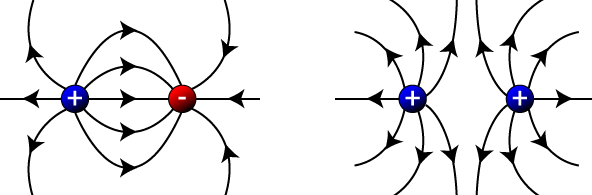
electrostatics - Why is electric field lines away from (+) and toward (-)?


I have a questions about the electric field lines. enter image description here


Well in the basic learning, we know that:


  1. The electric field lines extend away from a positive charge

  2. They move forward a negative charge


Let's take parallel plates, which make a uniform electric field.If we take the basic learning, which I mentioned, in accounts, it's very easy to understand that this is the direction of a positive charge object if we put the object between the plate (move away the positive charged plate and toward negatively charged plate).


The problem is if we put a negative charged object between. Isn't the electric field reversed ?


cosmology - When did the first carbon nucleus in the Universe come into existence?


I am a chemist with a passion for astrophysics and particle physics, and one of the most marvellous things I have learned in my life is the process of stellar nucleosynthesis. It saddens me how my colleagues point to the periodic table and draw compound structures so often, yet never seem to be curious about where the elements on which they rely came from, and completely miss the beauty underneath.


As far as I understand, there are several types of nucleosynthesis conditions (big bang, stellar, supernova, black hole accretion disk, artificial, pycnonuclear, and perhaps others), the first three of which are most important when discussing the composition of the Universe, but I wish to focus on an aspect of big bang nucleosynthesis.


The Universe became extremely hot after inflation (or so it is thought), and while cooling down there was a very brief period in which the temperatures and densities were adequate for protons and neutrons to exist and fuse into heavier elements. However, this period of nucleosynthesis was so brief that most of the nucleons formed in baryogenesis didn't even have time to fuse, ending up as hydrogen. Of the amount that did manage to fuse, almost all of it stopped at helium, helped by the exceptional stability of the $^4He$ nucleus relative to its neighbours. Only a tiny amount of lithium is said to have been made, and I've rarely heard anyone discussing elements heavier than that. It is often said that "metals" (in the astronomical sense) only really appeared after stellar nucleosynthesis began, but there was already a lot of matter around after baryogenesis ended (about the same amount as the $10^{80}$ baryons present now?), so even the tiniest atomic fraction of an element could correspond to galactic masses' worth of it.


It would be really neat if it turned out that carbon, the very stuff of life as we know it, didn't exist at all until over a hundred million years after the big bang, when the first generation of stars began to light up. However, I don't know if this is the case, as confirmation or refutation relies on precise quantitative modelling of the big bang nucleosynthesis. Is it possible to figure out when the first carbon nuclei came into existence? I tried using a search engine, but my specific query is completely drowned in links covering the more general aspects of nucleosynthesis.


Note: I suppose that if one were to consider the matter outside the observable Universe, then there probably were carbon nuclei even the tiniest timestep after nucleosynthesis began, because the sheer ridiculous amount of space expected to be out there could well overwhelm the nigh-impossible odds of carbon formation. Thus, the calculation is more interesting if limited to our observable volume.


Answer


The article The path to metallicity: synthesis of CNO elements in standard BBN attempts to quantify the amount of carbon produced during big bang nucleosynthesis.


It concludes that the ratio of carbon-12 formed to hydrogen was $~4 \times 10^{-16}$


with lesser amounts of carbon-13 and carbon-14.


classical mechanics - Moment of a force about a given axis (Torque) - Scalar or vectorial?

I am studying Statics and saw that: The moment of a force about a given axis (or Torque) is defined by the equation: $M_X = (\vec r \times \...