Monday, September 23, 2019

mathematics - Fair n-sided dice


I have recently bought a fair $10$-sided dice for generating equally distributed random numbers from the range $1,2,\ldots,10$. Let me describe this dice in some more detail. Consider a regular 5-gon $ABCDE$ in 3-dimensional space that is situated in the $xy$-plane so that its center lies in the origin. Consider a further point $F$ on the $z$-axis somewhere above the origin, and a point $G$ that results by reflecting $F$ across the origin. If one connects every corner of the 5-gon $ABCDE$ by two edges to $F$ and $G$, this will yield a polyhedron $P_{10}$ with 10 congruent triangular faces. My fair 10-sided dice is essentially $P_{10}$ with the sides labeled by the numbers 1,2,...,10. Throw it up into the air, look how it lands, and take the side on which it lands as your random number. (With a cube one always takes the top side, but $P_{10}$ has no top side). By the symmetry of $P_{10}$ it is obvious that all $10$ numbers are equally probable.


If I modify this construction and replace the regular 5-gon by a regular $n$-gon, I shall get a fair $2n$-sided dice with an even number of sides.


My question is whether there also exist fair $(2n+1)$-sided dice with an odd number of sides. By a fair dice I mean


  • a $(2n+1)$-sided polyhedron with $2n+1$ congruent sides,

  • so that the probability of landing on each of its sides is precisely $\frac{1}{2n+1}$.


Answer


A partial solution


You asked for the existence of a $(2n+1)$-sided polytope/die, so that all $2n+1$ sides are congruent and so that the probability of landing on each of these sides is precisely $1/(2n+1)$.


I do not see how to mathematically model the property that the probability of landing on each of the sides is precisely $1/(2n+1)$. This seems to need some assumptions from physics and/or mechanics. Instead, I propose a purely mathematical formulation of fairness:


Definition of fairness: A polytope is a fair die, if for any two sides there exists a symmetry of the polytope that maps one side into the other one.


This fairness definition works for the standard six-sided die (which is highly symmetric) and also for the 10-sided polytope that you describe in your puzzle. Note that the definition trivially implies congruence of any two faces.


I will prove below that for this definition of fairness, there does not exist a fair die with an odd number of sides.


Non-existence proof for an odd number of sides


(1) Suppose for the sake of contradiction that there exists a $(2n+1)$-sided polytope that is fair. Let $s$ denote the number of edges of every side. The polytope has altogether $2n+1$ sides, and every side has $s$ edges. Hence the total number of edges is $(2n+1)s/2$, as every edge is counted twice.


The polytope has $e=(2n+1)s/2$ edges and $s\ge3$ is an even integer.


(2) Consider a side of the polytope. The side has $s$ vertices, and we let $d_1\le d_2\le\cdots\le d_s$ denote the number of edges that are incident to these $s$ vertices. A vertex with $d_i$ incident edges is a vertex of $d_i$ different sides. Hence, the polytope contains exactly $(2n+1)/d_i$ vertices of this particular type. We conclude:


The polytope has $v=(2n+1)(\frac{1}{d_1}+\frac{1}{d_2}+\cdots+\frac{1}{d_s})$ vertices.


(3) Next we use Euler's polyhedral formula that says that a polytope with $f$ sides (faces), $e$ edges, and $v$ vertices must satisfy $v+f-e=2$. By plugging in $f=2n+1$ and the expressions derived in (1) and (2), we get


$(2n+1)(\frac{1}{d_1}+\frac{1}{d_2}+\cdots+\frac{1}{d_s}+1-\frac{s}{2})=2 ~~~~~~(*)$


Since $d_i\ge3$ for all $i$, we furthermore derive


$(2n+1)(s\frac{1}{3}+1-\frac{s}{2}) ~\ge~ (2n+1)(\frac{1}{d_1}+\frac{1}{d_2}+\cdots+\frac{1}{d_s}+1-\frac{s}{2}) ~=~ 2 $


Since $2n+1$ is positive, also the value $1-s/6$ in the other bracket must be positive; this implies $s\le5$. Since $s\ge3$ is an even integer, we arrive at the following fact:


$s=4$


(4) Since $s=4$, the equation $(*)$ now simplifies to


$(2n+1)(\frac{1}{d_1}+\frac{1}{d_2}+\frac{1}{d_3}+\frac{1}{d_4}-1)=2 ~~~~~~(**)$


If $d_1\ge4$, then the sum of the four reciprocals in $(**)$ would be at most $1$; a contradiction. We conclude $d_1=3$, and $(**)$ further simplifies to


$\frac{1}{d_2}+\frac{1}{d_3}+\frac{1}{d_4} ~=~ \frac{2}{3}+\frac{2}{2n+1} ~~~~~~(***)$


This only leaves four possible cases for $d_2$ and $d_3$ (in all other cases, the sum of the three reciprocals would be at most $2/3$):


  • (a) $d_2=3$ and $d_3=3$

  • (b) $d_2=3$ and $d_3=4$

  • (c) $d_2=3$ and $d_3=5$

  • (d) $d_2=4$ and $d_3=4$


(5) It remains to do the case work.


  • In case (a), equation $(***)$ turns into $d_4=(2n+1)/2$; this is impossible, as $d_4$ would not be integer.


  • In case (b), equation $(***)$ turns into $d_4=12(2n+1)/(2n+25)$. Then the odd number $2n+25$ must divide $3(2n+1)=6n+3$. Since $6n+75=3(2n+25)$, also the difference $6n+75-(6n+3)=72$ must be a multiple of the odd number $2n+25$; a contradiction.


  • In case (c), equation $(***)$ turns into $d_4=15(2n+1)/(4n+32)$. Then the odd number $15(2n+1)$ must be a multiple of the even number $4n+32$; another contradiction.


  • In case (d), equation $(***)$ turns into $d_4=6(2n+1)/(2n+13)$. Then the odd number $2n+13$ must divide $3(2n+1)=6n+3$. Since $6n+39=3(2n+13)$, also the difference $6n+39-(6n+3)=36$ must be a multiple of the odd number $2n+13$; the final contradiction.


(6) As all possible cases have ended up in a contradiction, we conclude that there is no fair die with an odd number of sides.

Sunday, September 22, 2019

language - The Babel Brotherhood - #1


Meta: If you find this kind of puzzle fun, I'd like to make a complete series with the same style. Let's see how it goes!


The Babel Brotherhood is composed of people from all around the world.


Two members of the Brotherhood, codenames Madrid and Washington, were on a dangerous infiltration mission to retrieve some secret documents. They were already inside the building, and Madrid was deactivating the silent alarm for the door of the office containing the documents. They both knew that if he failed, they would need to abort the mission immediately and run to the exit as fast as possible to avoid getting caught, and if he succeeded, they would need to quickly enter the office and retrieve the documents.


After some time working on the alarm, Madrid suddenly exclaimed a single word. Simultaneously, he opened the door (as he had deactivated the alarm successfully) and Washington started running in panic towards the exit.


What did Madrid exclaim, and why did Washington ran towards the exit?


Answer


I suspect that Madrid


is Spanish and exclaimed "Éxito!" meaning "success"


whereas Washington


is American and thought Madrid was telling him to head for the exit.


Quantum mechanics - how can the energy be complex?


In section 134 of Vol. 3 (Quantum Mechanics), Landau and Lifshitz make the energy complex in order to describe a particle that can decay:


$$ E = E_0 - \frac{1}{2}i \Gamma. $$


The propagator $U(t) = \exp(-i H t)$ then makes the wavefunction die exponentially with time. But also, $H$ is non-Hermitian.


My question: Do we have to modify the basic postulates of quantum mechanics (as described by Shankar, say, or the earlier sections of Landau & Lifshitz) to describe unstable particles?


general relativity - Is there a limit as to how fast a black hole can grow?


Astronomers find ancient black hole 12 billion times the size of the Sun.


According to the article above, we observe this supermassive black hole as it was 900 million years after the formation of the universe, and scientists find its extreme specifications mysterious because of the relatively young age of the Universe at that time.


Why would the 12 billion Solar Masses mass value be mysterious, unless there was a limit of sorts to the rate of mass consumption by a black hole? (naive point: Why would 900 million years not suffice for this much accumulation, keeping in mind that most supermassive stars which form black holes have life-spans of a few tens of millions of years at most?)


Answer


The accretion of matter onto a compact object cannot take place at an unlimited rate. There is a negative feedback caused by radiation pressure.


If a source has a luminosity $L$, then there is a maximum luminosity - the Eddington luminosity - which is where the radiation pressure balances the inward gravitational forces.


The size of the Eddington luminosity depends on the opacity of the material. For pure ionised hydrogen and Thomson scattering $$ L_{Edd} = 1.3 \times 10^{31} \frac{M}{M_{\odot}}\ W$$


Suppose that material fell onto a black hole from infinity and was spherically symmetric. If the gravitational potential energy was converted entirely into radiation just before it fell beneath the event horizon, the "accretion luminosity" would be $$L_{acc} = \frac{G M_{BH}}{R}\frac{dM}{dt},$$ where $M_{BH}$ is the black hole mass, $R$ is the radius from which the radiation is emitted (must be greater than the Schwarzschild radius) and $dM/dt$ is the accretion rate.


If we say that $L_{acc} \leq L_{Edd}$ then $$ \frac{dM}{dt} \leq 1.3 \times10^{31} \frac{M_{BH}}{M_{\odot}} \frac{R}{GM_{BH}} \simeq 10^{11}\ R\ kg/s \sim 10^{-3} \frac{R}{R_{\odot}}\ M_{\odot}/yr$$


Now, not all the GPE gets radiated, some of it could fall into the black hole. Also, whilst the radiation does not have to come from near the event horizon, the radius used in the equation above cannot be too much larger than the event horizon. However, the fact is that material cannot just accrete directly into a black hole without radiating; because it has angular momentum, an accretion disc will be formed and will radiate away lots of energy - this is why we see quasars and AGN -, thus both of these effects must be small numerical factors and there is some maximum accretion rate.


To get some numerical results we can absorb our uncertainty as to the efficiency of the process and the radius at which the luminosity is emitted into a general ignorance parameter called $\eta$, such that $$L_{acc} = \eta c^2 \frac{dM}{dt}$$ i.e what fraction of the rest mass energy is turned into radiation. Then, equating this to the Eddington luminosity we have $$\frac{dM}{dt} = (1-\eta) \frac{1.3\times10^{31}}{\eta c^2} \frac{M}{M_{\odot}}$$ which gives $$ M = M_{0} \exp[t/\tau],$$ where $\tau = 4\times10^{8} \eta/(1-\eta)$ years (often termed the Salpeter (1964) growth timescale). The problem is that $\eta$ needs to be pretty big in order to explain the luminosities of quasars, but this also implies that they cannot grow extremely rapidly. I am not fully aware of the arguments that surround the work you quote, but depending on what you assume for the "seed" of the supermassive black hole, you may only have a few to perhaps 10 e-folding timescales to get you up to $10^{10}$ solar masses. I guess this is where the problem lies. $\eta$ needs to be very low to achieve growth rates from massive stellar black holes to supermassive black holes, but this can only be achieved in slow-spinning black holes, which are not thought to exist!


A nice summary of the problem is given in the introduction of Volonteri, Silk & Dubus (2014). These authors also review some of the solutions that might allow Super-Eddington accretion and shorter growth timescales - there are a number of good ideas, but none has emerged as a front-runner yet.


quantum field theory - How does chirality of a massive fermion change with time?


For a massive fermions, like the electron, chirality is not conserved in time. It is not a good quantum number although it is Lorentz invariant. The Dirac Hamiltonian (in particular, the mass term in it) is then supposed to change the chirality.


Is it possible for an electron to start out in the exclusively left-chiral state at $t=0$ i.e., $e_L=\frac{1}{2}(1-\gamma_5)e$ and get the chirality flipped to $e_R=\frac{1}{2}(1+\gamma_5)e$ at a later time?


But this is problematic. If the electron is at any moment either exclusively left-chiral or exclusively right-chiral, it cannot have a mass at that moment because Dirac mass requires both chiralities to be present at the same time (except neutrinos). Isn't it? I think at any instant of time an electron is a admixture of both left-chiral and right-chiral components.


  1. Then, what exactly is the mass term doing to the chirality? Is it in some sense "changing the proportion" in which left-chiral and right-chiral components mix/add up to make up the electron?


  2. Is there a way to mathematically see what is happening to the chiral projections of a massive fermion field with time? I was thinking along the following line. The fermion field evolves in time as $\psi(\textbf{x},t)=e^{-iH_Dt}\phi(\textbf{x},0)e^{iH_Dt}$ and $\psi(\textbf{x},0)=\psi_L(\textbf{x},0)+\psi_R(\textbf{x},0)$. The next thing involves exponentiating the Dirac Hamiltonian $H_D$ which looks like a formidable task.


EDIT: This confusion arose because often in Feynman diagrams people use a "cross symbol" to show that mass term flipping $e_L\rightarrow e_R$ or $e_R\rightarrow e_L$. I don't understand what do people mean by this.


I know that the mass term $m\bar{\psi}\psi=m(\bar{\psi_L}\psi_R+\bar{\psi_R}\psi_L)$ can be thought of as an interaction where the first term takes $e_R\rightarrow e_L$ and second term $e_L\rightarrow e_R$. But this is incomplete understanding. I want to understand what happens to the electron field as whole because at any instant of time it consists of both chiralities.


Answer


Chirality is not well-defined for massive fields. A famous consequence of this fact are pion masses, which can be linked to Chiral Symmetry Breaking.


In the Lagrangian, you can define left- and right-handed Weyl fermions independently. A mass term will mix these, giving a massive Dirac fermion. Weyl fermions fulfill either $$ P_{L} \psi_L = \psi_L, \quad \text{or} \quad P_R \psi_R = \psi_R$$ but a Dirac fermion is not an eigenstate of the projection operators $$ P_{L,R} \psi_D \neq \alpha \psi_D. $$


There is a computational trick called a "mass insertion", which can be confusing in this regard:


A Dirac fermion can be considered as a coupled system of two Weyl fermions, where the mass is the coupling parameter. If a fermion's mass is small compared to the energy of a given process, one can approximate the Dirac fermion by its two (massless) Weyl components. The advantage is that for massless fields, loop integrals usually take much simpler forms.


Corrections to the massless case can then be included by adding a Feynman rule for the mass term in the Lagrangean, which is a biliear coupling between the left- and right-handed Weyl fermions. If you were to resum all possible mass insertions, the result is the same as if you had started with the massive Dirac fermion from the start. Since the underlying assumption of the approximation is that the mass is small compared to other energy scales in the theory, the corrections are usually small, though.


Sometimes, the diagram including a mass insertion is computed in order to show that the error induced by neglecting the mass is small indeed.


enigmatic puzzle - The lists of Adrian Puzzlinger


Adrian Puzzlinger has gone missing again. Even worse, for puzzle lovers, the latest puzzle under construction is missing as well. The puzzle police are puzzled by an imprint of aligned lists of numbers on a notepad on the desk in the puzzler parlor of Adrian Puzzlinger.


$$\small \boxed{ \begin{matrix} \\[-9mu] & & & 3 & 6 & 10 & 15 & 21 & 28 & 36 & \\[7mu] & & & 4 & 7 & 11 & 16 & 22 & 29 & 37 & \\[7mu] & & & 16 & 23 & 29 & 34 & 38 & 41 & 43 & \\[7mu] & & & 17 & 24 & 30 & 35 & 39 & 42 & 44 & \\[7mu] & 36 & 37 & 38 & 39 & 40 & 41 & 42 & 43 & 44 & \\[-9mu] \\ \end{matrix} } $$


What kind of puzzle was Adrian making?


As this kind of puzzle has assumed different aliases, the authorities need a full description of how Adrian used these lists, not just a name.


Other missing-puzzler case
The mess of Adrian Puzzlinger


Answer


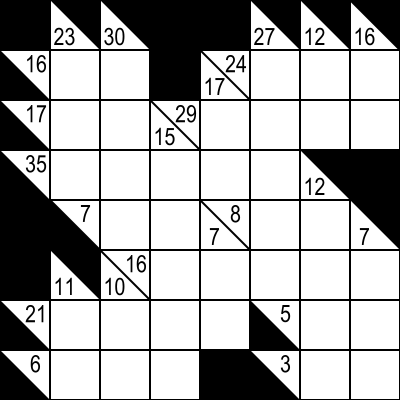
The puzzle is:


Kakuro $ \small\sf \kern6em example \! : $

solved Kakuro puzzle           unsolved Kakuro puzzle


because:


The numbers in the top row represent the minimum sum of a run of length n. min(2) =3, min(3) = 6 etc. Basically the triangle numbers. The numbers in the 4th row are the maximum sum of a run of length n. Row 2 is just one bigger than row 1, and row 3 is one less than row 4. Thus rows 1 to 4 represent all the sums that can appear in a run for which all elements are known. For example if the sum of a run of length 2 is 4, then you know the numbers must be 1 and 3. if the sum was 3, it must be 1 and 2. If the sum was 17, it must be 9 and 8, and if 16 it must be 7 and 9. This is true because you can't have the same number appearing twice in any row, so e.g. 4=2+2 is not allowed. Any other sum than those shown would permits multiple possible sets. E.g. a sum of 6 could be either 1,5 or 2,4. The last row is all possible sums of a run of length 8 for which all elements are known. for example 44 can only be 2,3,4,5,6,7,8,9. It seems that all possible sums with a unique set of elements are shown.


Edit:


actually the unique sum for a run of 9 is not shown (45). Maybe he was doing a kakuro problem which didn't have any 9-runs.


Annotated lists:


$$ \require{begingroup} \begingroup \def \S{\kern25.8mu} \small \begin{matrix} \sf \kern68mu 2 \S 3 \S 4 \S 5 \S 6 \S 7 \S 8 \\ \boxed{ \begin{matrix} \\[-9mu] & & & 3 & 6 & 10 & 15 & 21 & 28 & 36 & \\[-3mu] & & & 4 & 7 & 11 & 16 & 22 & 29 & 37 & \\[7mu] & & & 16 & 23 & 29 & 34 & 38 & 41 & 43 & \\[-3mu] & & & 17 & 24 & 30 & 35 & 39 & 42 & 44 & \\[7mu] & 36 & 37 & 38 & 39 & 40 & 41 & 42 & 43 & 44 & \\[-9mu] \\ \end{matrix} } \\ \kern2mu \sf 9 \S 8 \S 7 \S 6 \S 5 \S 4 \S 3 \S 2 \S 1 \end{matrix} ~~~~ \begin{array}{l} l ~=~ \textsf{row length} \\[19mu] \textsf{sum:} ~~~ 1 ~~~ 2 ~~\, \cdots ~~ (l{-}1) ~~~ l \\[-4mu] \textsf{sum:} ~~~ 1 ~\!\; (2) ~ \cdots ~~ (l{-}1) ~~~~~~ (l{+}1) \\[7mu] \textsf{sum:} ~~~ 9 ~\!\: (8) \; \cdots ~~ (m{+}2) ~~~~~~~~~~ m \\[-4mu] \textsf{sum:} ~~~ 9 ~~~ 8 ~~\, \cdots ~~ (m{+}2) ~~ (m{+}1) \\[6mu] \textsf{sum:} ~~ \textsf{all but } m, ~~~ \textsf{row length} = 8 \\[19mu] m ~= \unicode{8220}\textsf{missing}\unicode{8221} =~ 9-l \end{array} \endgroup $$


strategy - Shedding some light


There is a room with a single light bulb in it. Outside the room there are three light switches. You cannot see inside the room at all. Only one light switch turns on the light bulb. You may only enter the room once to find out which switch turns it on. The goal is to figure out which light switch turns on the light.


Answer


Label the switches A B and C.


Turn on A and B and wait for a while, then turn off A. Enter the room.


How to determine the switch?


On -> B
Off and cold -> C
Off and hot -> A


classical mechanics - Moment of a force about a given axis (Torque) - Scalar or vectorial?

I am studying Statics and saw that: The moment of a force about a given axis (or Torque) is defined by the equation: $M_X = (\vec r \times \...